
Most tools ask you to take their word for it. VITALS shows its work.
Validated psychology, patterns you can question, and data that stays yours from the first answer to the last. Here's exactly how it works, and why it holds up.
Decades of research behind every dimension
VITALS' six dimensions draw on validated psychological science: Jung's theory of psychological types, Cattell's 16 Personality Factors, and Holland's vocational interests. Dr. David Watterson, former Chairman of Cattell's own research institute, integrated these into the Watterson Personality Inventory, the instrument that powers VITALS.
Four letters is coarse. VITALS uses factor analysis, the method for finding the patterns under how you actually answer instead of sorting you into a type. Your 291 answers roll into 87 scored clusters that resolve into six dimensions.
Validation doesn't stop at launch. Outside researchers pressure-test the framework on an ongoing basis.
Decades of research behind every dimension
VITALS' six dimensions draw on validated psychological science: Jung's theory of psychological types, Cattell's 16 Personality Factors, and Holland's vocational interests. Dr. David Watterson, former Chairman of Cattell's own research institute, integrated these into the Watterson Personality Inventory, the instrument that powers VITALS.
Four letters is coarse. VITALS uses factor analysis, the method for finding the patterns under how you actually answer instead of sorting you into a type. Your 291 answers roll into 87 scored clusters that resolve into six dimensions.
Validation doesn't stop at launch. Outside researchers pressure-test the framework on an ongoing basis.
Your data stays yours
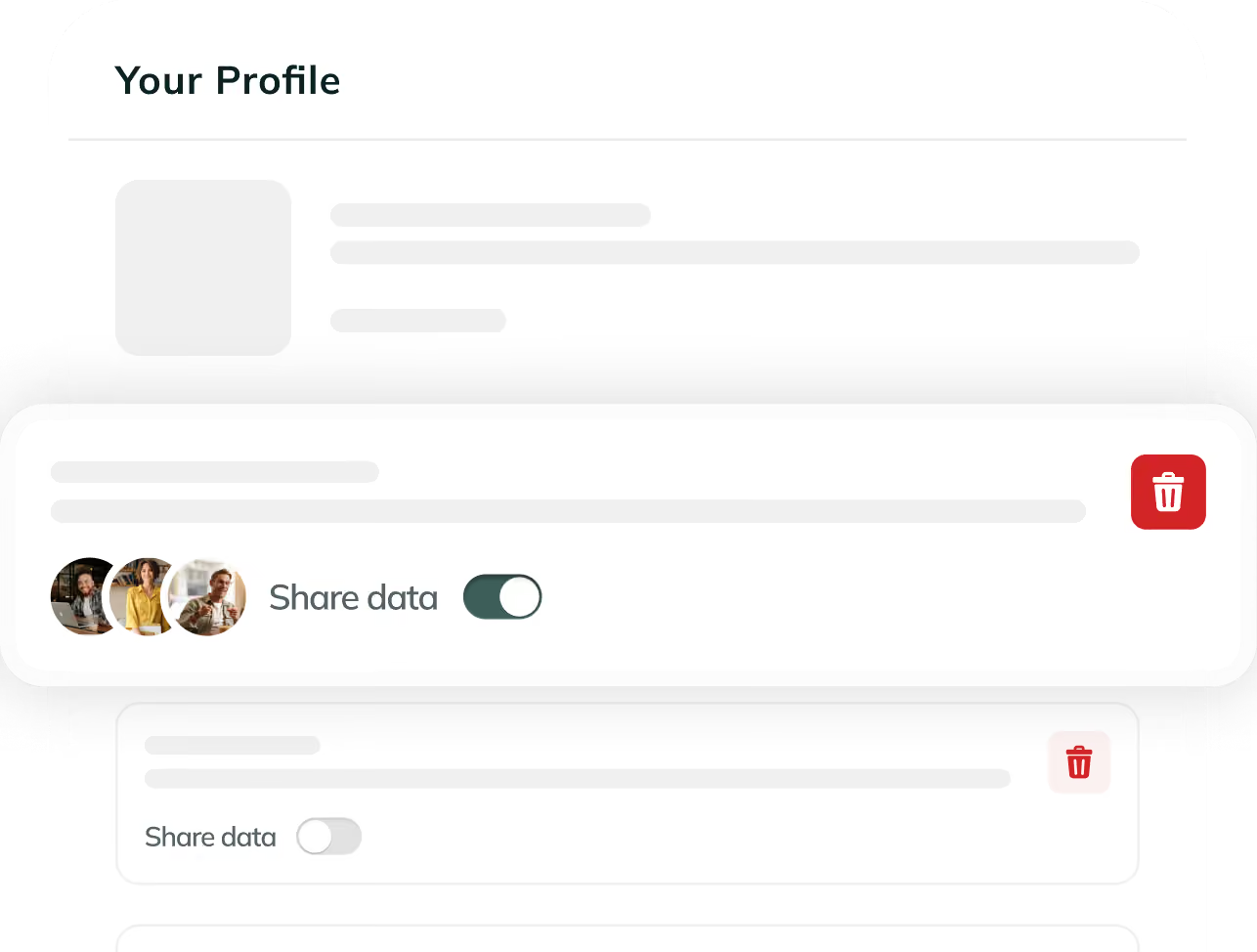
Self-knowledge only works if you trust where it lives. Ownership isn't a line buried in a privacy policy here, it's how the product is built. Your profile is yours: export it whenever you want, delete it whenever you want. When you delete it, we remove or de-identify your personal information, so what's left can no longer be tied back to you.
You decide what's shared and with whom. Nothing about your profile goes anywhere by default. We don't sell your personal information to advertisers or data brokers, that's not how VITALS makes money.
The point is control. The more honest you are with a tool like this, the more useful it gets, and people are only honest when they know they're the one in charge. So you stay in charge, start to finish.
Your data stays yours
Self-knowledge only works if you trust where it lives. Ownership isn't a line buried in a privacy policy here, it's how the product is built. Your profile is yours: export it whenever you want, delete it whenever you want. When you delete it, we remove or de-identify your personal information, so what's left can no longer be tied back to you.
You decide what's shared and with whom. Nothing about your profile goes anywhere by default. We don't sell your personal information to advertisers or data brokers, that's not how VITALS makes money.
The point is control. The more honest you are with a tool like this, the more useful it gets, and people are only honest when they know they're the one in charge. So you stay in charge, start to finish.
No black box. Every insight shows its work
Here's exactly how a result gets made, from what you tell us to something you can question.

Your responses
It starts with you. You answer a structured set of validated questions, designed to capture how you tend to operate rather than to catch you out. Your answers are the only raw material. Nothing is assumed about you before you've said it.

Your dimension profile
Your answers get scored across the six validated dimensions to build your profile. This is the measured part, the same factor-analytic method applied to you. The result isn't a verdict. It's a working model of how you tend to think, decide, and engage.

An insight you can question
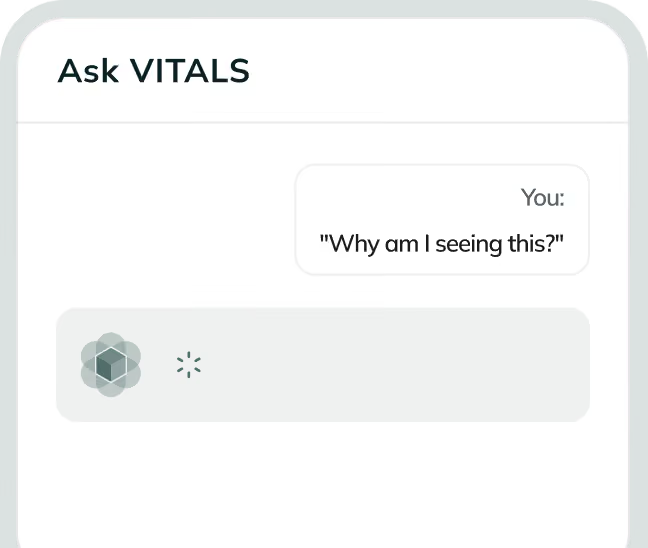
When an insight surfaces, it ties back to your profile, and you can always ask "Why am I seeing this?" to see what it's drawing on. We suggest. You decide. If something doesn't fit, say so, and your profile takes it in. The last word is yours.
What the framework stands on
We're not asking you to take the science on faith. These are the foundations VITALS is built on: real sources, real researchers, real ongoing work.
A lineage you can trace
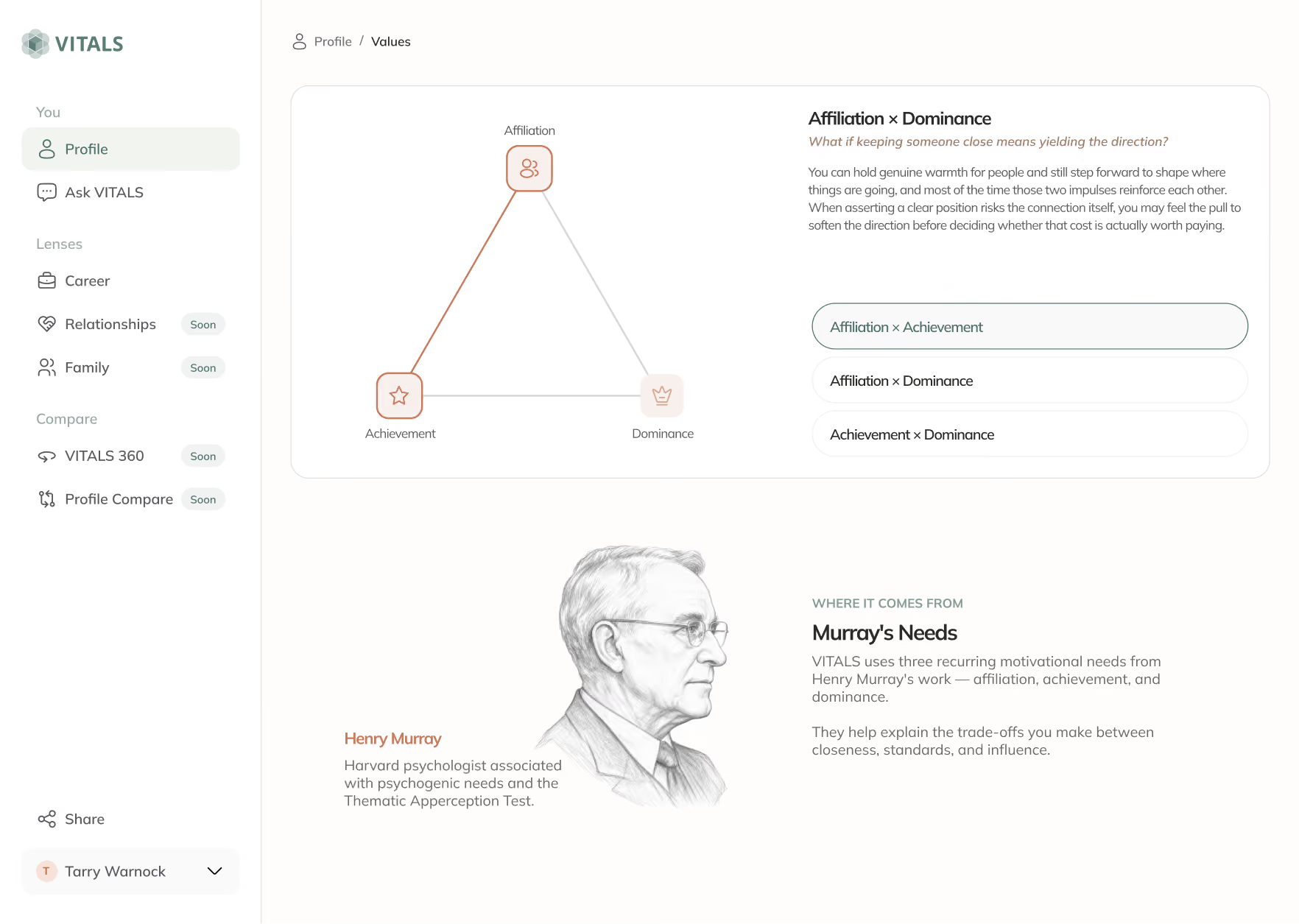
VITALS extends the 16PF, the factor-analytic model built by Raymond B. Cattell and one of the most studied instruments in psychology. Where VITALS reaches past personality into what you want and where you fit, it draws on Henry A. Murray's research on human needs and John L. Holland's model of vocational fit, which still underlies most career assessment today. Almost none of this was invented here, and that is the point.
Dr. David Watterson - researcher and practitioner
Co-founder of VITALS and creator of the assessment engine at its core, with a 30-plus-year body of work in applied psychology spanning assessment design, validation, and real-world use with individuals and organizations.
Ongoing academic collaboration
We work with leading researchers in applied psychology, including industrial-organizational psychologists, so that as VITALS evolves it stays rooted in validated research and new work is vetted by experts. The science stays under review, not frozen at launch.
Factor-analytic methodology
The established statistical approach behind the framework: identifying the underlying dimensions beneath individual responses, rather than sorting people into preset types or single labels.
Built for precision, not simplicity. Why you can trust what you see
Validated science
Built on validated psychology frameworks, including Jungian typology, Cattell's 16 Personality Factors, and Holland's interest themes.
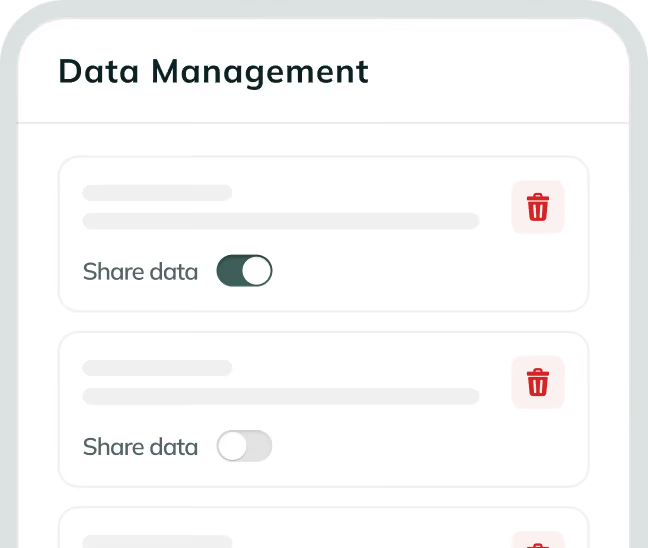
Your data stays yours
Export it or delete it any time you want. You decide what gets shared and with whom, and it's never sold.
No black box
Every insight shows its work. Ask "Why am I seeing this?" and you get the actual reasoning: the science sets the pattern, the AI only puts it into words.
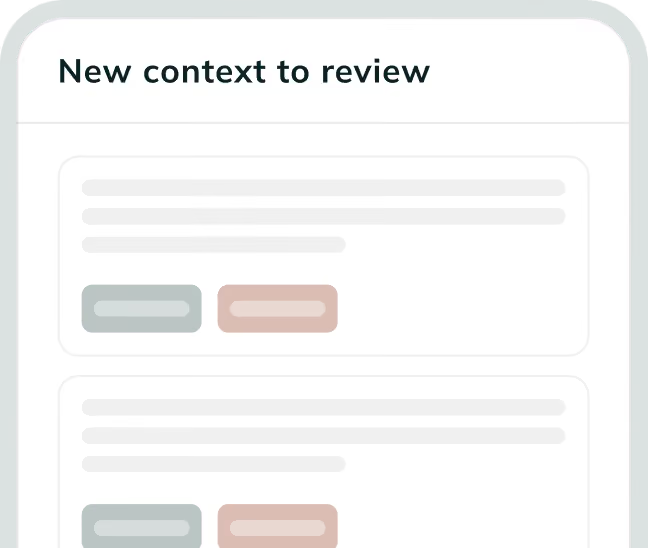
You stay in charge
VITALS surfaces patterns and lays out possibilities. It doesn't hand you a verdict, and it isn't built to keep you scrolling. You own your decisions.
Validated science
Built on validated psychology frameworks, including Jungian typology, Cattell's 16 Personality Factors, and Holland's interest themes.
Your data stays yours
Export it or delete it any time you want. You decide what gets shared and with whom, and it's never sold.
No black box
Every insight shows its work. Ask "Why am I seeing this?" and you get the actual reasoning: the science sets the pattern, the AI only puts it into words.
You stay in charge
VITALS surfaces patterns and lays out possibilities. It doesn't hand you a verdict, and it isn't built to keep you scrolling. You own your decisions.
See yourself clearly. Then decide.
It starts with the assessment: about 20 minutes, built on validated psychology, and a living profile that's yours to keep.

Questions worth answering before you start
Who's behind the science?
VITALS is built on established psychological science. Your assessment draws from validated frameworks including Jungian typology, Cattell's 16 Personality Factors, and Holland's vocational interest themes, research lineages that span decades. Your answers are scored deterministically against these validated patterns. AI is used only to put the results into language you can use.
Is this just another personality quiz?
No. A quiz sorts you into a type. VITALS asks 291 questions and never reads any of them on their own: your answers pool into 87 clusters, get scored against population norms, and resolve into six dimensions. What comes out isn't a category. It's a detailed picture of how you think, decide, and act, precise enough to guide a real decision.
What happens to my data?
Your data stays yours. Export it or delete it any time, control exactly what gets shared and with whom, and it's never sold. It lives in VITALS' own systems, not inside an AI company's training set.
How does VITALS decide what to show me?
The scoring itself is deterministic: your answers are matched against validated patterns from decades of data, no AI involved. Where we use AI is to put those patterns into language you can understand. Every insight comes with a "Why am I seeing this?" that shows you exactly where it came from. Want to know more? Just use Ask VITALS and dig in.
Does VITALS tell me what to do?
No, and that's on purpose. We show you the patterns, the tradeoffs, and why certain paths tend to fit people who work the way you do. We'll make suggestions and we'll always show the reasoning, but the decision stays yours. We're all looking for answers. The ones worth having aren't generic. They match who you are and the life you're actually living.
How is this different from ChatGPT?
ChatGPT is trained on everyone, so its answers are generic by design. It's built to predict the most likely answer, not to know what makes sense for you. VITALS starts by measuring who you are, then uses that profile as the context for every insight. Because it knows you, it can say more with less: the difference between advice for people like you and advice that's actually about you.
What does it cost?
Starting is free, and free means a real profile, not a teaser: you see yourself clearly before anyone asks you for anything. When you're ready for more there's one paid plan, with clear pricing shown up front and nothing you're locked into.